
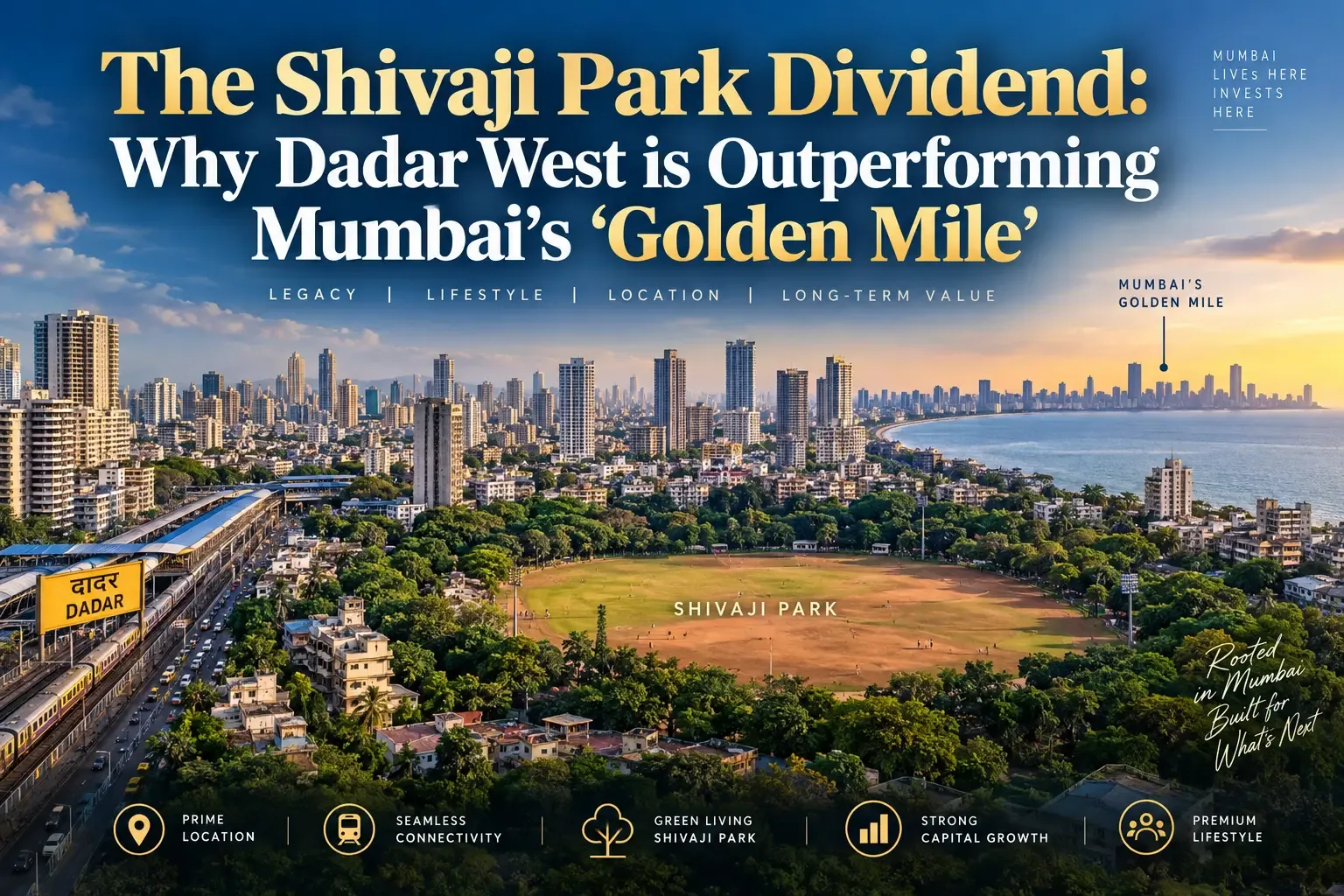
The Shivaji Park Dividend: Why Dadar West is Outperforming Mumbai’s ‘Golden Mile’
Purchasing luxury real estate in popular spots in Mumbai, like Bandra West or Worli, feels like buying the Nifty 50 during a peak since it already contains high value. For a wise investor, the real benefit lies in re-rating the micro market before anybody else notices. Over the past decade (2016–2026), the Dadar West area of Mumbai has steadily transformed itself from a transit zone known for its Kabootar Khana and Portuguese Church into South Mumbai's luxury area.
The statistics illustrate this significant transition: the cost of premium properties has risen from ₹32,000 per sq ft in 2016 to roughly ₹100,000 per sq ft today. The obvious example of a "Shivaji Park Dividend" in terms of cost of properties will be seen by most buyers in the price of 2BHK properties: from ₹1.5-2.5 Cr in 2016 to ₹3.28-6.71 Cr in 2026.
Takeaway 1: The Bandra Beater — Why Dadar West’s Growth is Counter-Intuitive
While being less known to outsiders, Bandra West is the obvious winner in terms of price growth. However, an analysis over a period of ten years reveals that the ultra-tier of Dadar West outperformed Bandra West's ultra-tier by demonstrating an annual growth of 11.1% compared to 6.4% in the case of the latter. Such superior performance stems from the so-called "Discovery Phase." In 2016, Bandra West was a mature asset, whose ultra-tier property cost ₹70,000 per square foot. The difficulty faced by such assets is "large number bias," when significant percentage increases become more challenging to obtain. In contrast, the ultra-tier of Dadar West was priced much lower in 2016 at about ₹32,000 per square foot. As high net worth individuals started to learn about the story of Shivaji Park between 2018 and 2024, a one-time price correction occurred which gave an additional boost to the re-rating of the asset.
Takeaway 2: The ₹57,000 Spread — A Market of Two Worlds
The Dadar West zone stands out by having the highest PSF spread of all the zones in South Mumbai. The difference between the least costly and the most expensive flats is ₹57,000 which creates a “Two Worlds” market for all kinds of budget ranges. Flats that will allow people to make their move from lower to higher budget range include West Avenue, whereas some of the most expensive flats can be found at Janai Heritage.
Price Tiers of Dadar West Zone (May 2026)
- Affordable Entry Tier (Under Construction, e.g., West Avenue): ₹40,178 – ₹52,000/sqft
- Branded Mid-Tier (Under Construction, e.g., Suraj Lumina): ₹57,000 – ₹65,000/sqft
- Premium Tier (Flagship Developer Projects): ₹65,000 – ₹80,000/sqft
- Ultra-Tier (Shivaji Park Peak, e.g., Jan
Takeaway 3: The Irreplaceable Anchor — Shivaji Park’s Scarcity Power
And the main reason for the popularity of the area lies in the 27.5-acre Shivaji Park. Real estate jargon calls the park a "permanent supply cap." In contrast to Lower Parel, where the land from old mill areas like National Mills is developed into large residential blocks that drive prices low because of excessive supply, the premium nature of Dadar West is maintained by virtue of its location. The number of structures with unobstructed view of the park is limited and dwindling each year, since the existing CHSs are being reconstructed into vertical structures. This generates an irreducible gap between supply and demand.
"Each year, the number of new structures with an unobstructed view of Shivaji Park reduces..."
Takeaway 4: The Connectivity Compound Effect
The Dadar West area has moved on from being solely a station-based zone to becoming a corridor-oriented one based on infrastructural developments. It is still the sole micro-market affected by the Western and Central Railway lines, but today’s “Connectivity Dividend” is based on three distinct factors:
- Metro Line 3 (Aqua Line): The upcoming 2025/2026 opening of the Dadar metro station, particularly its Dharavi junction connection, gives a locational premium of around 5-8%.
- Coastal Road (Phase 1): Having opened in 2024, the road brought about a reduction in the time taken to reach Worli and South Mumbai, thereby turning Dadar West into a genuine “South Mumbai” destination for high-end commuting professionals.
- Forward Alpha (Line 7A): The projected Dadar extension for Metro Line 7A is viewed as a “one-time premium event” yet to come.
Takeaway 5: The Developer Oligopoly and the Price Floor
One of the key aspects of the resilience of Dadar West is its oligopoly-type development structure that is predominantly informal. Indeed, only a few construction companies have a monopoly in Dadar West – namely, Sugee Group, Suraj Estate, Buildarch, and Dipti Group. In turn, such structure helps avoid “distress discounting.” Namely, during the 2020 pandemic when the resale market of the whole Mumbai fell by 5-8%, the price of newly developed housing units did not drop in Dadar West. These companies simply preserved their project portfolio rather than tried to sell at any cost. Due to the fact that dealing with old CHS committees is a serious obstacle for the supply, such developers maintain a high price floor. The main question here is not about how high the ceiling is but about whether Sugee can keep acquiring frontage plots.
2031 Projections: Is the Ceiling Now the Floor?
As we look toward 2031, the "discovery phase" has largely concluded, but the scarcity phase is Getting started now. The ultra segment will see its base case PSF touch levels of ₹1,20,000 to ₹1,40,000 as the final frontage plots are sold out. It's a choice that comes in at the high-net-worth investor level. Choose between the liquidity of stocks or invest in the "protected scarcity" of an iconic property next to the park. In the Dadar West market,...offers massive Comparison of equity investment returns versus unleveraged assets. Once you factor in the advantages of LTCG and indexation, "Shivaji Park Dividend" remains one of the most amazing examples of wealth generation in urban India. For 2026, the issue is not about how well Dadar West fits into the South Mumbai environment, but what you are prepared to pay to look at a view which cannot be duplicated.