
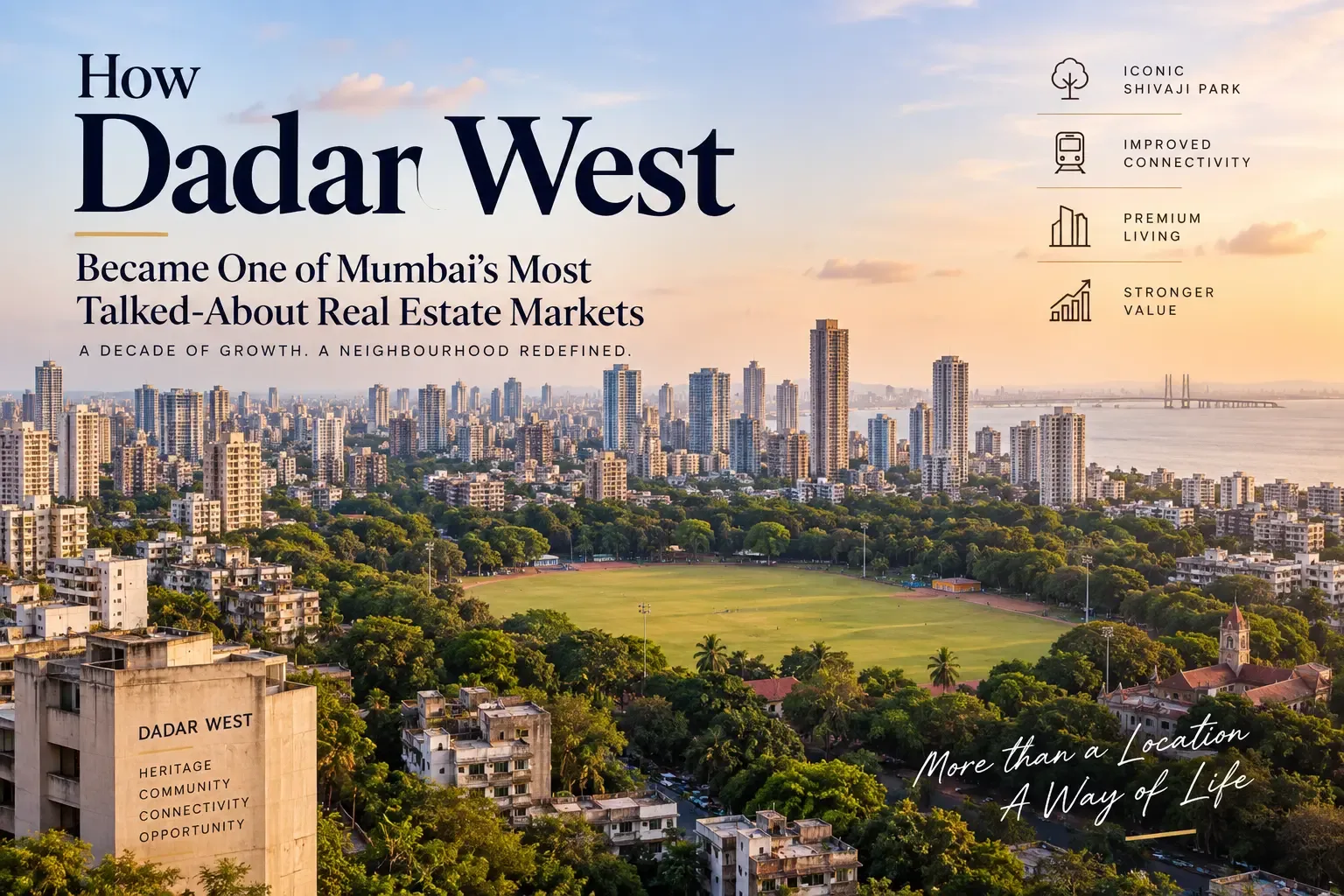
From ₹25,000 to ₹97,000: How Dadar West Became One of Mumbai’s Most Talked-About Real Estate Markets
In 2016, buying a good 2 BHK in Dadar West could cost you anywhere between ₹1.5 Cr and ₹2.5 Cr. At the time, the area was known for its old-Mumbai charm, strong connectivity, and cultural identity. It was a well-established residential neighbourhood, but it wasn't necessarily the first place investors considered when talking about luxury real estate.
Fast-forward to May 2026, and the picture looks very different. A 2 BHK in the same broader market can now command a price of up to ₹6.71 Cr.
So, what changed?
Dadar West has gradually evolved from a traditional residential hub into one of Mumbai's sought-after premium housing markets. Buyers are looking beyond the size of an apartment. They are paying attention to location, open spaces, redevelopment quality, privacy, and the kind of lifestyle a property offers.
And when it comes to Dadar West, few factors are as important as its proximity to Shivaji Park.
Shivaji Park: The View That Keeps Getting More Valuable
Shivaji Park has always been a defining part of Dadar's identity. Its large open space, greenery, and heritage make it a rare feature in an increasingly crowded city.
For someone buying a premium home, the difference between looking at another building and looking out over an open park can be substantial.
That is where the idea of scarcity comes in.
Dadar West doesn't have the kind of large, undeveloped land parcels that allowed areas such as Lower Parel to undergo extensive mill-land redevelopment. Here, new residential supply often depends on redeveloping individual cooperative housing society plots.
That process can take years. It involves negotiations with residents, approvals, construction, and significant financial commitments.
As a result, premium homes in specific locations cannot be created overnight.
But there is another side to the story. As more towers come up, some previously open views may become obstructed. This means that an apartment with a genuinely unobstructed Shivaji Park view could become harder to find.
The question is how much buyers are willing to pay for that view, and whether the premium will hold over time.
For developers launching projects close to the park, the combination of location and limited competing inventory can support premium pricing. However, the exact impact depends on the project, its frontage, height, view corridor, and the surrounding development.
Dadar West vs Bandra West: Is the Market Really Catching Up?
Bandra West has been a premium residential destination for decades. It has an established reputation, a strong lifestyle offering, and a deep pool of affluent buyers.
Dadar West has a different appeal.
It offers central connectivity, established neighbourhoods, proximity to Shivaji Park, and access to several important parts of Mumbai. Over the years, some buyers have also looked toward Dadar as an alternative to the congestion and pricing of other premium locations.
This has led to comparisons between the two markets.
The figures cited in the original analysis suggest the following 10-year CAGR:
Dadar West ultra-premium: 11.1%
Bandra West ultra-premium: 6.4%
These numbers need to be verified against consistent transaction data before they can be treated as an established comparison. The outcome can change depending on whether the data measures asking prices, registered sales, or a specific category of apartments.
Still, the broader question is worth asking: Can a neighbourhood with limited land supply and growing premium demand continue to attract buyers who previously focused on established luxury markets?
Real Estate vs the Nifty 50: Does Property Still Make Financial Sense?
When property prices rise sharply, investors naturally compare real estate returns with the stock market.
The Nifty 50 is often used as a benchmark, but comparing it with a single residential property requires some care. The two investments have different costs, risks, liquidity, and income characteristics.
Consider leverage.
Suppose you purchase a ₹5 Cr property using ₹1 Cr of your own money and ₹4 Cr in financing. If the property appreciates, the percentage change in your equity can be much larger than the property's percentage appreciation, before accounting for interest, taxes, and other expenses.
The same leverage works in reverse when prices fall.
Taxation also matters, but property tax benefits should not be assumed. The applicable rules depend on the purchase and sale dates, holding period, and the relevant tax provisions.
For a serious investor, the right comparison should include:
Total property appreciation.
Rental income, if applicable.
Interest costs and maintenance.
Stamp duty and transaction expenses.
Tax on sale.
Liquidity and the time required to exit.
A rising price per square foot is useful information. It isn't a complete investment return calculation.
The Wide Price Gap Within Dadar West
One of the most interesting aspects of Dadar West is the range of properties available within the locality.
A buyer looking for a modern upgrade may consider one set of projects, while someone seeking a high-end residence with a park view may be looking at an entirely different segment.
The reported May 2026 pricing bands are:
Market segment Reported price range
Entry tier ₹40,178-₹52,000/sq ft
Mid-tier ₹57,000–₹65,000/sq ft
Ultra-premium ₹80,000–₹97,186/sq ft
Projects cited in the original analysis include EIRENE, Avhad Oasis, Suraj Lumina, Sakura, and Janai Heritage.
These figures should be checked against project-specific pricing and actual transactions. Carpet area, floor level, view, construction stage, amenities, and exact location can all influence the final price.
A buyer paying ₹22 Cr for a premium residence is evaluating a different product from someone purchasing an apartment as an upgrade from an older society building.
That variety is part of what makes the market interesting.
Connectivity Is Changing the Way Buyers Look at Dadar
Dadar West has traditionally benefited from its railway connectivity and central location. New infrastructure has added another dimension to the conversation.
The Coastal Road has changed travel routes across Mumbai, while Metro Line 3 has expanded the city's underground transit network.
However, the specific benefits to each part of Dadar West depend on station access, road connections, and the destinations involved. Claims about travel-time savings and a precise percentage increase in property prices should be supported by local data.
For a homebuyer, the practical calculation is simple:
How much easier will your daily commute become, and how much are you prepared to pay for that convenience?
A buyer travelling regularly to BKC, Nariman Point, Lower Parel, or other business districts may assess the location differently from someone whose work and lifestyle are concentrated in central Mumbai.
Connectivity adds value, but the value is personal and property-specific.
Why Redevelopment Matters So Much
In Dadar West, redevelopment is central to the future of the housing market.
Many older buildings occupy locations that are difficult to replicate. Redevelopment can bring newer construction, updated amenities, improved layouts, and modern building systems to those locations.
At the same time, these projects can be complicated. Society negotiations, regulatory approvals, construction timelines, and funding requirements all influence the outcome.
Developers such as Sugee, Suraj, Buildarch, and Dipti have been associated with residential projects in Mumbai. Their individual projects should be evaluated on their own merits, including location, delivery record, construction quality, and pricing.
The 2020 stamp duty reduction in Maharashtra also influenced homebuyer decisions during the pandemic. Its effect on transaction volumes and prices in Dadar West needs to be assessed using relevant local market data.
One thing is clear: Redevelopment can create new premium homes, but the supply of truly exceptional locations remains limited.
What Could Happen by 2031?
The projections cited in the original analysis place Dadar West's 2031 prices at:
Mid-tier: ₹80,000–₹90,000 per sq ft.
Ultra-premium: ₹1,20,000–₹1,40,000 per sq ft.
These are projections, not guaranteed outcomes.
Future prices will depend on several factors, including:
The pace of redevelopment.
Demand from high-income buyers.
Interest rates and financing costs.
Mumbai's economic performance.
New infrastructure.
The number of premium homes entering the market.
Whether buyers continue to pay a substantial premium for open views.
Limited land supply can support property values, but it doesn't guarantee that prices will rise every year. Even a desirable neighbourhood can experience periods of slower growth.
The Real Question: How Much Is a Shivaji Park View Worth?
Dadar West has come a long way over the past decade. Its established neighbourhoods, central location, and premium redevelopment projects have attracted growing attention from homebuyers and investors.
But the next five years will raise an important question.
Will buyers continue paying a premium for a permanent park-facing view, or will property prices eventually reach a level where the premium becomes difficult to justify?
The answer will depend on demand, supply, buyer preferences, and the actual quality of the homes being offered.
For anyone considering a property in Dadar West, the most important thing is to look beyond the headline price per square foot.
Study the location. Check the view. Understand the redevelopment details. Compare recent transactions. And make sure the property fits your financial goals.
Because in a market where every square foot matters, the difference between a good purchase and an expensive mistake can come down to the details.