
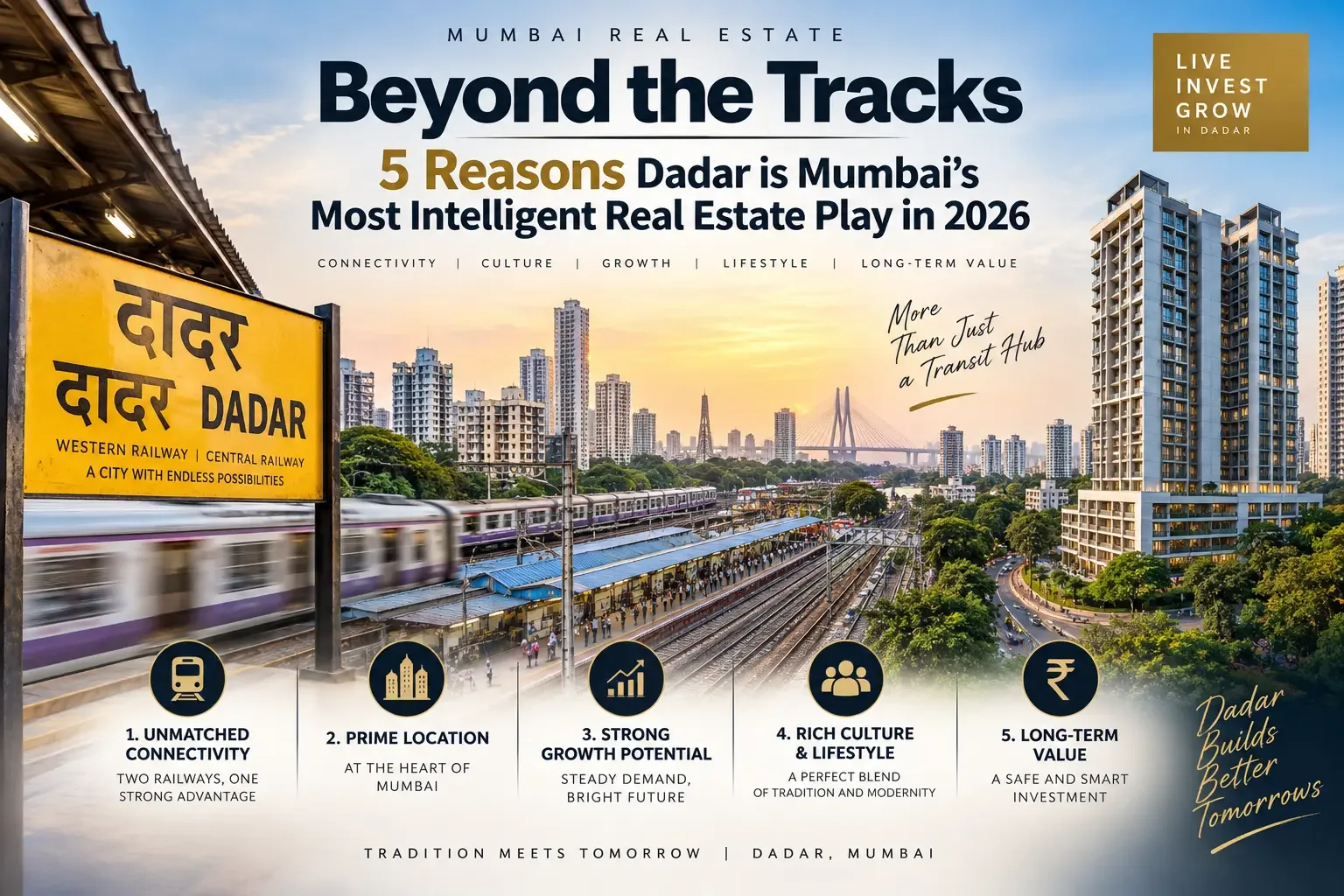
Beyond the Tracks: 5 Reasons Dadar is Mumbai’s Most Intelligent Real Estate Play in 2026
The 800-Metre DivideOn the map of Mumbai real estate strategy, there is no line more meaningful than the railway tracks dividing Dadar. With an 800-meter divide creating two separate micro-markets, here is one fact that is clear when charting out the 2026 scenario – Dadar has graduated from being merely a waiting room to becoming a boardroom for Mumbai. It has become a recession-proof core.
While suburban markets can generate supply through lateral growth by acquiring new land, Dadar’s strength lies in redevelopment driven supply. Hence, Dadar becomes a natural choice for downside protection and provides the most logical play for end users among all markets in the city. It could be a working professional commuting to BKC and looking for efficiency or even an extended family wanting continuity of culture, Dadar will serve you best.
The Connectivity Arbitrage: Why Minutes Matter More than Pin Codes Dadar is Mumbai’s most versatile interchange, the only node where the Western, Central, and Harbour lines converge within a 500-metre radius. For the 2026 professional, this triple-threat connectivity is the ultimate arbitrage. It provides the ability to reach CST in 10 minutes, Churchgate in 22 minutes, and the BKC gateway via Bandra in just 8 minutes.
The efficiency of rail transport often beats those of car-based communities. A citizen from Dadar will be able to get to the center of BKC through rail and auto transport within 25-30 minutes and will definitely avoid traffic jams encountered by citizens of Bandra East and Worli."Dadar station is Mumbai’s most versatile interchange...
₹44,000-₹65,000/sqft - here lies the essence of the connectivity premium - “Mumbai's best-commuted address at Mumbai's best mid-range prices.” Property Butler 20% Dividend: East vs. West – The Pricing ParadoxThe dilemma of whether to go for Dadar East or West is the matter of choosing between utility and asset value. In the May 2026 market scenario, the depth of the market can be seen in its lack of options; there are merely 9 listed projects out of 4 in the East compared to 25 listed out of 11 in the West.
East Dadar (approx. ₹40,841 to ₹46,000 PSF): The area caters to the “transient” professional—namely the VP who travels from BKC or Sion and values their money. The unique outlier in this segment is The Baya Company’s Sky Crest, which is a design-oriented project that provides deck units with dual sea and city views.
Dadar West (approx. ₹45,299 - ₹53,000+ PSF): This is the arena of long term "lifestyle" residents. In this case, the premium will be paid for social infrastructure of multi-generational nature. Luxurious high end examples include The Palette & Janai Heritage, with boutique options like AVHAD Oasis (RTM) offering a means of access to the area.The Identity Premium of Shivaji Park & the Sea View PremiumDadar West possesses a special "Identity Premium" in its own right in relation to Shivaji Park.
This is the non-substitutable social infrastructure; this is the ground on which the city’s culture operates. The proximity to the park provides a “perimeter premium” of 1km within which prices disconnect from the rest of the market.In case of Janai Heritage , sea facing units command prices up to ₹97,000/sqft for the Shivaji Park lifestyle. But for the savvy investor, there are still opportunities in the West side. The reality check comes in the form of a sea facing 2BHK unit at Promesa West End that can be acquired for ₹2.60 Cr.Infrastructure as a Growth Driver:The Roadmap for 2026-2030Dadar is poised at the infrastructure inflection point where “time-distance compression” is revaluing the whole neighborhood.
Metro Line 3: In operation since October 2025, the Metro line has completely changed the way South Mumbai and SEEPZ are accessed.
The BDD Chawl Redevelopment: This is the huge 90-acre project that is often overlooked. With the demolition of these old buildings to give way to skyscrapers, the neighborhood will have its “halo effect” like the one in Lower Parel.
Phase 2 of Coastal Road Project: This development project will help cut down travel time between Dadar West and Nariman Point to 15-20 minutes by 2027-2029.Relying upon the precedent set by Sea Link, which helped properties in close proximity increase their value by 18%-25% within 24 months, sea-facing Dadar properties will grow 11% annually till 2030.
The Hidden Numbers: Stamp Duty, Cess, and the Actual Price of Entry
For the curator of urban dwelling, the "actual" price of entry is more than simply the negotiated price of the carpet area. For the year 2026, transaction costs are an important budget element:
Stamp Duty: 6% for male applicants and 5% for female applicants. Important to note that the 1% Metro Cess is included in the calculation.
Registration: Maximum of ₹30,000 for properties beyond ₹30 lakh. It is important to note here that these fees are calculated based on whichever is higher between market value and the Ready Reckoner value of the government. This is because the LTV ratio is calculated only using the market value, and not taking into account these registration fees which can run into hundreds of thousands of rupees.
Conclusion: The Power of the End-UserDadar continues to be dominated by end-users. Its strength is in the certainty that the demand exists because of its utility and community, and not because of any speculative bubbles. Looking ahead at the coming decade, it is the scarcity of redevelopment that makes sure that Dadar continues to be a liquid and highly utilitarian property.The ultimate question for the buyer in 2026: “Commute Utility” or “Lifestyle Premium”?